
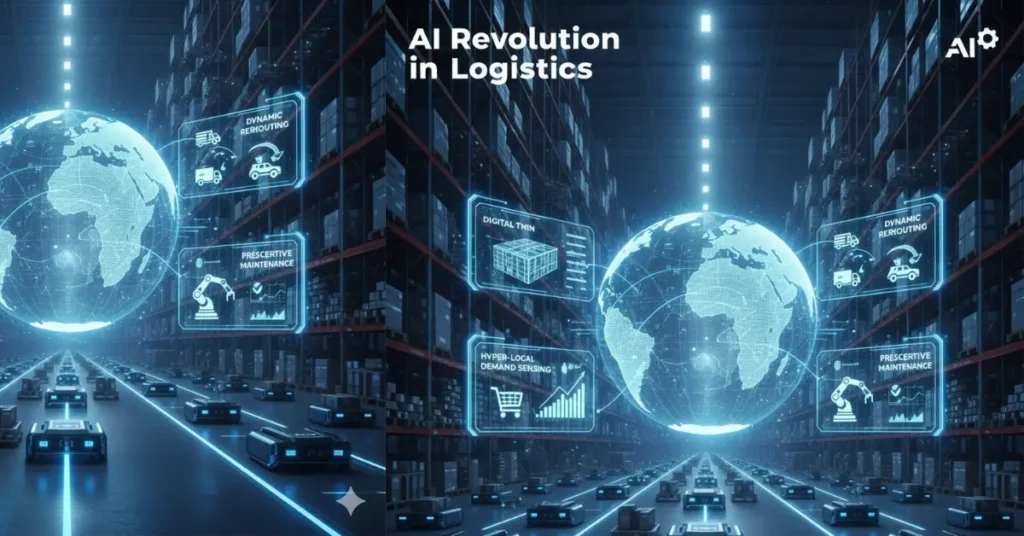
The AI Revolution in Logistics: How Artificial Intelligence is Reshaping the Global Supply Chain
Introduction: The Dawn of a New Era in Logistics
What is the AI Revolution in Logistics? The world of logistics, once a domain of manual processes, intricate spreadsheets, and reactive problem-solving, is undergoing a monumental transformation. We stand at the precipice of a new era, an era not merely defined by automation, but by intelligence. Artificial Intelligence (AI) is no longer a futuristic concept whispered in tech circles; it is here, actively reshaping the global supply chain, driving efficiencies, predicting disruptions, and fundamentally altering how goods move from origin to destination. In 2026, we’re witnessing AI shift from a supporting player to the central operating system for supply chains worldwide, propelling businesses into an age of unparalleled agility and resilience.
This comprehensive guide will delve deep into the profound impact of AI on logistics, exploring its multifaceted applications, tangible benefits, and the exciting future it promises. From predictive analytics to autonomous operations, we’ll uncover how AI is not just optimizing but revolutionizing supply chain management, offering a competitive edge in an increasingly complex and interconnected global marketplace.
The Imperative for AI in Modern Logistics: Navigating Complexity
The global supply chain operates within a volatile, uncertain, complex, and ambiguous (VUCA) environment. Geopolitical shifts, climate change, unprecedented demand fluctuations (remember the pandemic-driven surge in e-commerce?), and rapidly evolving customer expectations create a constant state of flux. Traditional logistics models, often linear and rigid, struggle to cope with such dynamic pressures. This is where AI emerges not just as a tool, but as a necessity.
AI’s unparalleled ability to process vast datasets, identify intricate patterns, and generate actionable insights at lightning speed makes it the perfect antidote to supply chain complexity. It empowers organizations to move beyond mere reaction, enabling them to anticipate, adapt, and even proactively shape their operational realities.
The Pillars of AI Transformation in Supply Chain Management
AI’s influence permeates every facet of the supply chain. Let’s explore the key pillars of this transformation:
1. From Predictive to Proactive Decision-Making: Anticipating Tomorrow Today
One of the most significant shifts AI brings is the evolution from simply predicting what might happen to enabling proactive interventions before issues escalate. This is the hallmark of an intelligent supply chain.
- Dynamic Rerouting and Risk Mitigation: Imagine a major port strike announced just hours before your critical cargo ship is due to arrive, or a sudden, severe weather event closing a major transit route. In traditional logistics, this would cause massive delays and costs. AI agents, however, are constantly monitoring global events—from geopolitical tensions and labor disputes to extreme weather patterns and infrastructure failures. These systems can automatically analyze real-time data from hundreds of sources, identify potential disruptions, and instantly suggest or even execute alternative routes, carriers, or modes of transport. This drastically reduces transit times, minimizes disruption, and safeguards delivery schedules.
- Hyper-local Demand Sensing and Inventory Optimization: Gone are the days of broad, national or regional forecasts that often miss nuanced market shifts. AI now leverages an incredible array of data points to predict demand with unprecedented accuracy at a hyper-local level. This includes analyzing social media trends, local news, economic indicators, seasonal patterns, competitor activities, and even real-time weather forecasts. By understanding granular demand fluctuations, AI ensures that the right inventory is positioned in the right local warehouse or distribution center before the order is even placed. This minimizes stockouts, reduces excess inventory, and optimizes storage costs.
- Prescriptive Maintenance for Assets: Fleets of vehicles, material handling equipment, and warehouse robots are the lifeblood of logistics. Downtime due to unexpected breakdowns can be catastrophic. AI analyzes sensor data from these assets – temperature, vibration, pressure, mileage, usage patterns – to predict equipment failure with remarkable precision. This allows for scheduled, proactive maintenance rather than reactive repairs, significantly reducing operational downtime, extending asset lifespan, and cutting maintenance costs by up to 35%.
2. The Rise of “Physical AI” and Smart Warehousing: Beyond Automation
Warehouses are no longer just storage spaces; they are intelligent, dynamic hubs powered by “Physical AI” – where intelligent software meets robotic hardware.
- Autonomous Mobile Robots (AMRs) and Cobots: The evolution of robots in warehouses is astounding. Autonomous Mobile Robots (AMRs) have moved beyond simple, pre-programmed tasks. Equipped with advanced computer vision, machine learning algorithms, and sophisticated sensors, they can navigate complex, dynamic environments, learn from their surroundings, and safely collaborate with human workers. They optimize picking paths, sort packages, move heavy loads, and perform inventory counts with unparalleled speed and accuracy. Collaborative robots (cobots) work alongside humans, taking over repetitive or ergonomically challenging tasks, enhancing productivity and safety.
- Digital Twins for Supply Chain Simulation: A groundbreaking development is the creation of “digital twins” – exact virtual replicas of an entire supply chain, from a single warehouse to a global network. These sophisticated models integrate real-time data from every touchpoint, allowing businesses to run thousands of “what-if” simulations daily. Companies can test the impact of a sudden 20% increase in fuel costs, a major canal blockage, a new trade tariff, or a surge in customer orders before they happen in the real world. This capability provides invaluable insights, allowing for optimal strategic planning and rapid response.
- Vertical Automation and Space Optimization: As urban real estate becomes scarcer and more expensive, AI-managed vertical storage systems are becoming a standard. These systems, combined with advanced robotics, allow facilities to maximize storage capacity within the same physical footprint, sometimes tripling it. AI algorithms optimize storage locations based on demand, retrieval frequency, and even product dimensions, ensuring efficient space utilization and rapid access.
3. Autonomous Orchestration in Procurement and Freight Management
AI is increasingly taking over the laborious and often time-consuming “paperwork” and negotiation aspects of logistics, freeing human teams to focus on strategic relationships and complex problem-solving.
- Autonomous Negotiation and Carrier Selection: AI agents are now capable of end-to-end procurement processes. They can issue Requests for Quotation (RFQs), evaluate carrier bids based on a multitude of factors including historical performance, reliability, sustainability metrics, and current market rates. Furthermore, advanced AI can even negotiate rates for spot freight, identify optimal contract terms, and flag potential risks in agreements, all with minimal human intervention.
- Intelligent Document Processing and Compliance: Cross-border trade is notorious for its mountains of paperwork and complex compliance requirements. AI-powered Document Intelligence solutions are revolutionizing this. They can instantly classify customs forms, validate commercial invoices, analyze bills of lading, and detect inconsistencies or errors in documentation that would previously cause weeks of delay or costly penalties. This significantly accelerates customs clearance and reduces the administrative burden.
- Optimal Route and Load Planning: Beyond simple GPS, AI-driven routing algorithms consider an astounding array of variables: real-time traffic, weather conditions, road closures, delivery window constraints, driver hours-of-service regulations, fuel costs, and vehicle capacities. They create the most efficient multi-stop routes and optimize load configurations to maximize vehicle utilization, reducing mileage, fuel consumption, and emissions.
4. Enhancing Customer Experience and Last-Mile Delivery
In the age of instant gratification, customer experience is paramount. AI plays a crucial role in meeting and exceeding these expectations, particularly in the critical “last mile.”
- Personalized Delivery Options and Real-time Updates: AI enables logistics providers to offer highly personalized delivery options, from precise time slots to alternative pickup locations. Customers receive proactive, real-time updates on their shipment’s status, often with AI-powered chatbots handling inquiries, reducing the load on customer service teams.
- Optimized Last-Mile Logistics: This is arguably the most complex and expensive part of the supply chain. AI algorithms optimize delivery routes for individual parcels, considering traffic, pedestrian zones, parking availability, and even package dimensions. This includes coordinating autonomous delivery vehicles (drones and ground robots) in designated areas, predicting optimal loading sequences for delivery vans, and dynamically adjusting routes based on unforeseen events.
- Predictive Customer Service: AI can anticipate potential delivery issues (e.g., a package running late) and proactively inform the customer, sometimes even before the customer is aware of the delay. This transparency builds trust and improves satisfaction.
5. Sustainability as a Core AI-Driven Metric
In 2026, “green logistics” is no longer just a marketing buzzword; it’s a fundamental operational requirement and a competitive differentiator. AI is indispensable in achieving sustainability goals.
- Real-time Carbon Footprint Tracking: AI-powered dashboards provide granular, real-time visibility into the carbon emissions generated by every single shipment, every vehicle, and every warehouse operation. This allows companies to make data-driven decisions to optimize for the most sustainable transport options, switch to eco-friendly packaging, and identify areas for significant emissions reduction.
- Circular Economy Integration and Reverse Logistics: AI plays a pivotal role in enabling the circular economy. For returns management (reverse logistics), AI algorithms can quickly assess the condition of returned items, determine the optimal path (refurbish, recycle, resell, repair), and coordinate the reverse flow efficiently. This minimizes waste and maximizes resource utilization.
- Energy Efficiency in Warehouses: AI systems manage lighting, HVAC, and power consumption within intelligent warehouses, adjusting usage based on occupancy, time of day, and environmental conditions, leading to substantial energy savings.
The Strategic Advantages of AI-Powered Logistics
Beyond operational efficiency, AI offers profound strategic benefits:
- Enhanced Resilience and Agility: AI’s ability to foresee disruptions and adapt rapidly builds a supply chain that can withstand shocks and pivot quickly to changing market demands.
- Significant Cost Reduction: Optimization across routing, inventory, maintenance, and procurement translates into substantial savings in fuel, labor, storage, and operational overhead.
- Improved Customer Satisfaction: Faster, more reliable, and transparent deliveries lead directly to happier customers and stronger brand loyalty.
- Data-Driven Innovation: The wealth of data processed by AI provides unparalleled insights into market trends, operational bottlenecks, and opportunities for service innovation.
- Competitive Differentiation: Businesses leveraging AI gain a distinct advantage, offering superior service levels, faster time-to-market, and greater operational stability.
The Road Ahead: Challenges and Opportunities
While the benefits are immense, the journey to a fully AI-driven supply chain is not without its challenges. These include:
- Data Integration and Quality: AI thrives on data, meaning businesses need robust data infrastructure and strategies to ensure data quality, consistency, and accessibility across fragmented systems.
- Talent Gap: A skilled workforce capable of implementing, managing, and optimizing AI solutions is crucial. Investment in training and upskilling existing employees, as well as attracting new talent, is paramount.
- Interoperability: Ensuring different AI systems and platforms can communicate seamlessly across diverse partners in the supply chain (carriers, suppliers, customers) is a complex task.
- Cybersecurity: As systems become more interconnected and intelligent, the risk of cyber threats increases, necessitating robust security protocols.
- Ethical Considerations: Ensuring fair and unbiased AI decision-making, particularly in areas like labor scheduling or supplier selection, is an ongoing ethical responsibility.
However, these challenges are outweighed by the transformative opportunities. The companies that embrace AI now are not just future-proofing their operations; they are actively defining the future of global commerce.
Conclusion: AI – The Brain of Tomorrow’s Supply Chain
The digital transformation driven by Artificial Intelligence is fundamentally reshaping the logistics landscape. It’s moving beyond merely optimizing existing processes to creating entirely new paradigms of efficiency, resilience, and customer satisfaction. From predictive analytics guiding proactive decisions to autonomous robots orchestrating warehouse operations and AI agents managing complex procurement, the benefits are tangible and far-reaching.
For businesses looking to thrive in the volatile global marketplace, embracing AI in their supply chain management is no longer optional; it’s an imperative. The future of logistics is intelligent, interconnected, and highly adaptive – and AI is the brain powering this incredible evolution. Are you ready to lead the charge?
Frequently Asked Questions (FAQs) about AI in Logistics
Q1: What is the primary role of AI in supply chain management?
A1: The primary role of AI in supply chain management is to process vast amounts of data to identify patterns, predict future outcomes, and enable proactive, intelligent decision-making across all operational areas. This ranges from optimizing routes and inventory to automating warehouse processes and enhancing customer service, ultimately driving efficiency, resilience, and cost savings.
Q2: How does AI improve supply chain visibility?
A2: AI significantly improves supply chain visibility by integrating data from numerous sources (IoT sensors, GPS, ERP systems, external market data) in real-time. It then analyzes this data to provide comprehensive insights into the exact location, status, and estimated arrival times of goods, potential disruptions, and performance metrics across the entire network.
Q3: Can AI help with last-mile delivery challenges?
A3: Absolutely. AI is crucial for solving last-mile delivery challenges by optimizing delivery routes to account for real-time traffic, weather, and delivery windows; efficiently loading vehicles; coordinating autonomous delivery robots; and providing precise, real-time updates to customers, leading to faster, more cost-effective, and satisfying deliveries.
Q4: Is AI replacing human jobs in logistics?
A4: While AI and automation are taking over repetitive, data-intensive, and physically demanding tasks, they are not primarily replacing human jobs. Instead, AI is augmenting human capabilities, creating new roles focused on AI management, data analysis, strategic planning, and complex problem-solving. It allows human workers to shift from operational tasks to higher-value activities.
Q5: What are “digital twins” in the context of logistics?
A5: A “digital twin” in logistics is a virtual, real-time replica of a physical supply chain asset (like a warehouse, vehicle, or even the entire network). It integrates live data to simulate real-world conditions, allowing companies to run “what-if” scenarios, test optimizations, predict outcomes, and identify potential issues before they occur in the physical world.
Q6: How does AI contribute to sustainable logistics?
A6: AI contributes to sustainable logistics by optimizing routes to reduce fuel consumption and emissions, identifying opportunities for efficient load consolidation, tracking and reporting real-time carbon footprints, and managing reverse logistics more efficiently to reduce waste and promote circular economy principles.
Q7: What kind of data does AI use in supply chains?
A7: AI in supply chains utilizes a diverse range of data, including historical sales data, real-time sensor data from IoT devices (vehicles, warehouse equipment), GPS data, weather forecasts, traffic conditions, social media trends, geopolitical news, economic indicators, supplier performance data, customer feedback, and inventory levels.
Related Posts
Supply Chain Technology: How the Next Wave of Tools Is Rewiring Logistics
Supply Chain Technology is no longer optional — it’s the backbone of resilient, efficient, and sustainable logistics. This article explores […]
Read More →
Warehouse Management Systems: A Real-World, Down-to-Earth Solution for Today’s Warehouses
A friendly, conversational explainer on Warehouse Management Systems (WMS), how they work, why they matter, and how they can actually […]
Read More →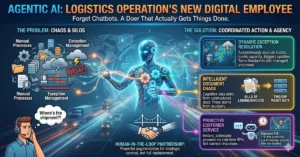
Agentic AI: Your Logistics Operation’s New Digital Employee
Forget Chatbots. It’s Time for Agentic AI That Actually Gets Things Done. Alright, let’s have a real talk about Agentic […]
Read More →