
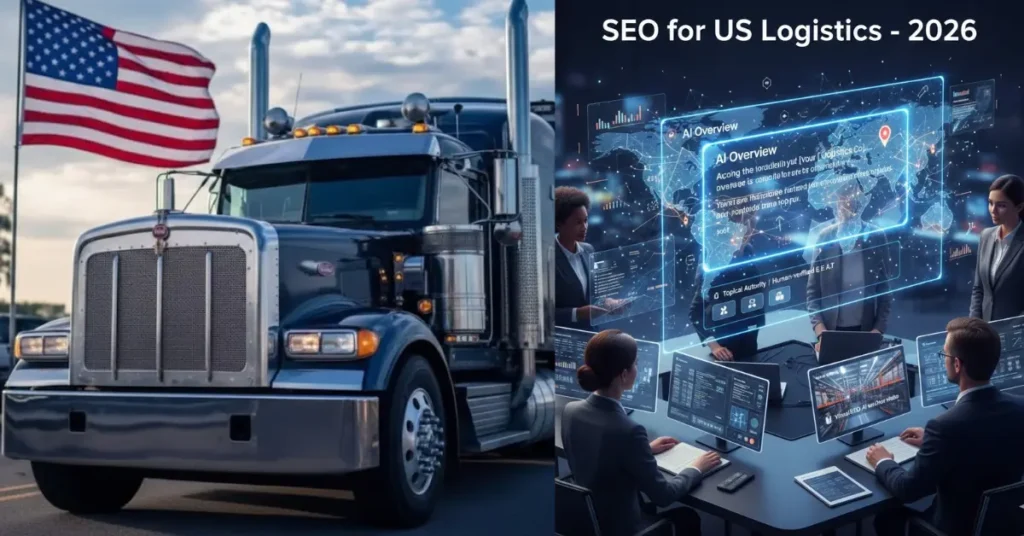
SEO For US Logistics : How SEO is Changing the Way US Logistics Companies Get Leads in 2026
Lets explore the evolution of SEO For US Logistics in 2026. Discover how AI-driven search, Answer Engine Optimization (AEO), and verified E-E-A-T are helping logistics companies outpace the competition and capture high-intent leads in a zero-click world.
In 2026, the traditional “blue links” of the internet have been replaced by a dynamic, AI-driven ecosystem. For US logistics companies—from freight forwarders in New Jersey to 3PL giants in Chicago—this shift has fundamentally changed how they find and convert leads.
Gone are the days of just “ranking for keywords.” Today, SEO is about dominating the AI Overview, proving E-E-A-T (Experience, Expertise, Authoritativeness, and Trustworthiness), and capturing micro-intents before a competitor even gets a look.
Here is how SEO is redefining lead generation for the logistics industry in 2026.
1. The Rise of “Answer Engine” Optimization (AEO)
In 2026, many shippers don’t click on websites anymore. They ask their AI assistants—like Google Gemini, ChatGPT, or Perplexity—complex questions: “Find a 3PL in the Southeast specializing in cold chain for pharmaceuticals with a 99% on-time rate.”
Logistics companies are moving away from long-form “fluff” and toward Structured Data and Zero-Click Content.
- The Strategy: Instead of 2,000-word articles about “What is Logistics?”, companies are creating highly structured, data-rich pages that AI can easily parse.
- The Lead Gen Impact: By becoming the “cited source” in an AI summary, a logistics firm gains instant authority. If the AI says, “According to techtransithub, shipping rates for LTL are stabilizing,” that’s a high-intent lead in the making.
2. E-E-A-T: Experience is the New Currency
With AI-generated content flooding the web, search engines now prioritize “Human-Verified” experience. For a US logistics provider, this means your SEO strategy must focus on case studies, real-world data, and expert authorship.
- Verified Expertise: Google now looks for “lived experience.” Blog posts written by your VP of Operations about navigating port strikes in Savannah will outrank generic AI content every time.
- Case Study SEO: Lead generation now thrives on “proof-based” search queries. Leads are searching for “results of implementing AI route optimization in midwest trucking,” and the companies with the best data-backed stories win.
3. Optimizing for “Dark Traffic” and Branded Search
SEO in 2026 isn’t just about Google; it’s about Search Everywhere Optimization. Potential leads are researching your company on LinkedIn, industry forums, and inside private Slack communities.
The Branded Search Flywheel
The more people search for your company by name, the more search engines view you as a “topical authority.”
- Omnichannel Presence: Successful logistics firms are using SEO to support their social selling.
- The Result: When a lead sees your expert commentary on LinkedIn and then searches for your brand on Google, your SEO-optimized “Trust Hub” (testimonials, certifications, and real-time tracking demos) closes the deal.
4. Hyper-Local SEO for Urban Micro-Fulfilment
As US logistics shifts toward urban micro-fulfilment centers (MFCs) to meet 1-hour delivery demands, local SEO has become granular.
- The Shift: It’s no longer enough to rank for “Logistics USA.” Companies are now optimizing for “Micro-fulfilment options in Brooklyn” or “Last-mile delivery near O’Hare Airport.”
- Inventory-Driven Search: SEO now integrates with live warehouse data. If a lead searches for “available temperature-controlled storage in Phoenix,” companies with real-time inventory synced to their search listings are capturing the lead instantly.
5. Visual and Multimodal SEO
In 2026, search is no longer just text. It’s video, images, and even “Search by Sight.”
- Video Dissection: Search engines now “watch” your videos. A 60-second clip of your automated sorting facility in action is indexed, and AI can pull that specific clip to answer a user’s question about “automated warehousing tech.”
- Interactive Tools: SEO-optimized freight calculators and “carbon footprint estimators” are the ultimate lead magnets. They provide value (capturing intent) while ranking for high-value technical queries.
Comparison: Traditional SEO vs. 2026 Logistics SEO
| Feature | Past SEO (Keyword Era) | 2026 SEO (Intent & AI Era) |
| Primary Goal | Clicks to the website | Dominating the AI response/citation |
| Content Type | Static blog posts | Multimodal (Video, Data, Interactive) |
| Trust Signal | Backlink quantity | Verified E-E-A-T & Case Studies |
| Search Intent | Broad (e.g., “Freight companies”) | Micro-intent (e.g., “LTL rates for hazmat”) |
Conclusion: The Shift from Traffic to Authority
The “SEO game” for US logistics in 2026 is no longer a race for the most traffic—it’s a race for the most trust. By shifting focus toward AI-readiness, verified human expertise, and hyper-local precision, logistics companies are transforming their websites from digital brochures into autonomous lead-generation machines.
If your company isn’t appearing as a cited authority in the AI summaries your prospects are reading daily, you aren’t just losing rank—you’re becoming invisible.
FAQs
1. Is traditional keyword research dead for logistics?
Not dead, but evolved. In 2026, we focus on semantic clusters and conversational prompts rather than single-word keywords. Instead of “trucking,” we optimize for the questions shippers ask their AI.
2. How long does it take to see leads from 2026 SEO strategies?
While traditional SEO took 6–12 months, AI-optimized content can be indexed and cited in summaries within days if the technical schema and authority signals are strong.
3. What is the “Zero-Click” trend?
This refers to users getting their answers directly on the search results page (via an AI Overview) without clicking a link. Logistics companies adapt by ensuring their brand and contact info are part of that AI-generated answer.
4. Do I still need a blog?
Yes, but not for “SEO fluff.” Your blog in 2026 serves as a Knowledge Base for AI to learn about your expertise and as a “Trust Hub” for leads who want to verify your claims after an AI recommends you.
Related Posts
How to Use the Inventory Turnover Equation to Optimize Your Stock Levels in 2026
Lets talk about Inventory Turnover Equation. In the world of business, sitting still is often the same as moving backward. […]
Read More →
Top 10 Logistics Companies in the World 2025: Leaders Shaping Global Trade
Lets explore the Top 10 Logistics Companies in the World 2025, The global logistics industry is the backbone of modern […]
Read More →
Warehousing and Logistics :The Engine of Commerce
What is Warehousing and Logistics? The modern global economy is characterized by a rapid, continuous flow of goods from manufacturer […]
Read More →