
How to Calculate Export Pricing: Understanding EXW, FOB, CIF, and DDP
Learn how to calculate export pricing with detailed explanations of EXW, FOB, CIF, and DDP terms. Understand key export pricing formulas, Incoterms, and cost responsibilities between buyers and sellers.
In the world of international trade, one of the most common challenges exporters face is deciding how to calculate export pricing. Setting the right export price means balancing profitability while staying competitive in global markets. To do this correctly, exporters must understand the export pricing formula under different Incoterms — standardized international trade terms that define the responsibilities of buyers and sellers.
The most widely used export pricing methods are EXW (Ex Works), FOB (Free On Board), CIF (Cost, Insurance, and Freight), and DDP (Delivered Duty Paid). Each of these terms outlines who pays for what, who takes responsibility at each stage, and how pricing should be calculated.
In this guide, we’ll break down each method in detail so you can confidently set accurate export prices and improve your global competitiveness.
1. What Is Export Pricing?
Export pricing refers to the process of determining how much to charge an overseas buyer for a product. Unlike domestic pricing, export pricing includes additional cost factors such as shipping, insurance, customs duties, packaging, and international logistics.
The export pricing formula depends on the agreed Incoterm, which defines how far the seller’s responsibility extends in delivering goods to the buyer.
In simple terms:
Export Price = Product Cost + Export-Related Costs + Profit Margin
However, each trade term modifies this formula by adding or removing specific cost components.
2. Why Export Pricing Is Important
Understanding export pricing is essential for both buyers and sellers because it:
- Defines responsibilities clearly: Each Incoterm outlines who handles shipping, insurance, and import duties.
- Prevents financial disputes: Both parties know what’s included in the price.
- Improves competitiveness: Correct pricing ensures you remain profitable while offering fair value.
- Supports transparency in trade: Buyers and sellers can easily compare offers from multiple suppliers using standardized pricing terms.
3. The Four Main Export Pricing Methods
Let’s explore each method — EXW, FOB, CIF, and DDP — in detail to understand how export prices are calculated.
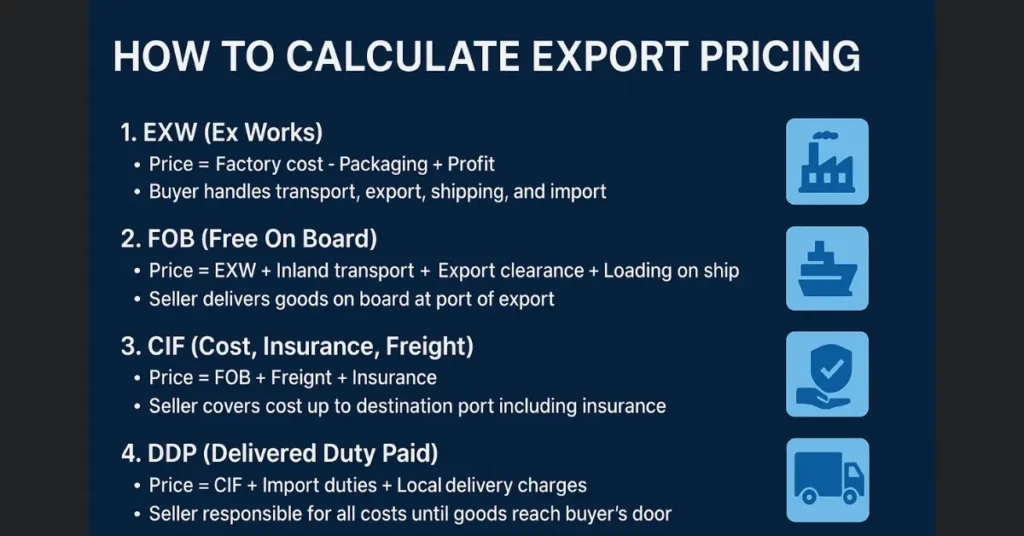
1. EXW (Ex Works)
Meaning:
EXW, or Ex Works, is the simplest and most seller-friendly export pricing term. Under EXW, the seller’s responsibility ends at their factory or warehouse. The buyer takes charge of all logistics — including transport, export clearance, shipping, and import procedures.
Formula:
EXW Price = Factory Cost + Packaging + Profit
Key Points:
- The seller only needs to make the goods available at their premises.
- The buyer arranges and pays for all transportation and customs formalities.
- EXW pricing is ideal for experienced buyers with strong logistics networks.
Example:
If a factory in China sells machinery to a buyer in Germany on EXW terms, the buyer must handle everything — from loading at the factory to delivery in Germany.
Advantages:
- Minimal risk for the seller.
- Simple and straightforward quotation.
Disadvantages:
- Buyer faces complex logistics and potential export clearance issues.
2. FOB (Free On Board)
Meaning:
FOB, or Free On Board, is one of the most commonly used Incoterms in export trade. Here, the seller delivers the goods to the port of export, handles export clearance, and loads the goods onto the shipping vessel. Once the goods are onboard, the risk transfers to the buyer.
Formula:
FOB Price = EXW + Inland Transport + Export Clearance + Loading Charges
Key Points:
- The seller delivers goods onboard at the port of origin.
- The buyer takes over responsibility from the port, including sea freight and insurance.
- FOB is ideal when the buyer wants control over the main transport route.
Example:
An exporter in India ships textiles to the USA on FOB Mumbai terms. The seller delivers the goods to Mumbai Port, clears them for export, and loads them on the vessel. From that point onward, the buyer handles the freight and insurance.
Advantages:
- Balanced responsibility between buyer and seller.
- Commonly accepted and easy to compare globally.
Disadvantages:
- Seller must manage export logistics up to port, which can add complexity.
3. CIF (Cost, Insurance, and Freight)
Meaning:
CIF, or Cost, Insurance, and Freight, is a trade term where the seller covers all costs up to the destination port, including ocean freight and insurance. Once the goods reach the destination port, the buyer assumes responsibility for unloading, import duties, and inland delivery.
Formula:
CIF Price = FOB + Freight + Insurance
Key Points:
- The seller pays for transport and insurance until the destination port.
- The buyer handles customs clearance, duties, and delivery to final location.
- CIF is often used when the buyer prefers convenience and fewer logistics concerns.
Example:
A Brazilian coffee exporter sells to a French importer under CIF Le Havre terms. The exporter arranges and pays for shipping and insurance to Le Havre Port. The importer then handles unloading and delivery within France.
Advantages:
- Buyer gets an all-inclusive delivered-to-port cost.
- Seller can negotiate better freight rates due to experience.
Disadvantages:
- Buyer has less control over shipping and insurance arrangements.
4. DDP (Delivered Duty Paid)
Meaning:
DDP, or Delivered Duty Paid, is the most comprehensive and buyer-friendly Incoterm. Under DDP, the seller takes full responsibility for delivering goods to the buyer’s doorstep, including all freight, insurance, customs duties, and taxes.
Formula:
DDP Price = CIF + Import Duties + Local Delivery Charges
Key Points:
- Seller manages every cost and risk until goods reach the buyer’s location.
- Buyer only needs to receive the shipment — all formalities are handled by the seller.
- DDP offers maximum convenience to buyers but involves high risk for sellers.
Example:
A laptop manufacturer in Japan sells products to a retailer in Canada on DDP Toronto terms. The manufacturer handles shipping, insurance, import duties, and even last-mile delivery to the retailer’s warehouse.
Advantages:
- Complete service for the buyer.
- Enhances seller’s reputation for reliability.
Disadvantages:
- Seller bears high costs and potential import compliance risks.
4. EXW vs FOB vs CIF vs DDP — Key Differences
| Term | Seller’s Responsibility | Buyer’s Responsibility | Price Includes |
| EXW | Goods ready at factory | All transport & customs | Factory cost + packaging + profit |
| FOB | Transport to port & loading | Sea freight & import | EXW + inland transport + export clearance |
| CIF | Up to destination port with insurance | Import duties & local delivery | FOB + freight + insurance |
| DDP | Full delivery to buyer’s door | None (receives goods) | CIF + import duties + delivery |
This comparison clearly shows how pricing and responsibilities evolve from EXW (seller minimal) to DDP (seller maximum).
5. Choosing the Right Export Pricing Method
Selecting the right export pricing term depends on several factors:
- Experience level: New exporters often start with FOB or CIF for a balanced approach.
- Buyer’s preference: Some buyers prefer handling logistics (EXW), others want door delivery (DDP).
- Product value: For high-value goods, CIF or DDP ensures insurance coverage.
- Market competitiveness: Including freight and insurance may make your offer more appealing.
A good rule of thumb:
If you want simplicity, go with EXW.
If you want control, use FOB.
If you want customer convenience, choose CIF or DDP.
6. How to Calculate Export Pricing Step by Step
Here’s a simplified export pricing calculation example:
- Factory cost: $1,000
- Packaging: $50
- Profit margin: $150
→ EXW Price = $1,200 - Inland transport + export clearance: $100
→ FOB Price = $1,300 - Freight + insurance: $200
→ CIF Price = $1,500 - Import duties + local delivery: $300
→ DDP Price = $1,800
By applying this step-by-step export pricing formula, you can easily quote prices for different Incoterms.
7. Tips for Accurate Export Price Calculation
- Include all hidden costs: Customs paperwork, packaging materials, bank charges, and logistics fees.
- Check exchange rates: Currency fluctuations can affect profitability.
- Review insurance coverage: Ensure goods are insured up to the correct point.
- Use freight forwarders: They can help calculate accurate CIF or DDP rates.
- Stay updated on Incoterms 2020 rules: These define current global standards for trade responsibilities.
8. Final Thoughts
Learning how to calculate export pricing is crucial for any business involved in global trade. Whether you’re dealing under EXW, FOB, CIF, or DDP, understanding the export pricing formula helps you quote competitive prices, manage risks, and maintain profitability.
By mastering these export pricing methods, exporters can not only simplify negotiations but also gain a clear edge in international markets. Remember: the right Incoterm doesn’t just affect your cost — it defines your business relationship and trust with your global partners.
Read Also: Top 10 Logistics Companies in the World 2025: Leaders Shaping Global Trade
Related Posts

3D Warehouse in Supply Chain Management
Discover how 3D warehouse modeling and digital twins are helping businesses maximize vertical space, boost safety with VR training, and […]
Read More →
Top 10 Logistics Companies in the World 2025: Leaders Shaping Global Trade
Lets explore the Top 10 Logistics Companies in the World 2025, The global logistics industry is the backbone of modern […]
Read More →
Mastering CEVA Logistics Tracking: A Complete Guide to Global Shipment Visibility
Lets explore CEVA Logistics Tracking. In today’s fast-paced global economy, the ability to monitor cargo in real-time is no longer […]
Read More →