
Agentic AI: Your Logistics Operation’s New Digital Employee
Forget Chatbots. It’s Time for Agentic AI That Actually Gets Things Done.
Alright, let’s have a real talk about Agentic AI. I know, I know—another day, another AI buzzword. But stick with me. This one’s cutting through the noise for a reason, especially in the messy, real-world fields of logistics and tech tools. It’s not about a chatbot that can write a poem; it’s about a digital worker that can actually fix a supply chain snafu. Think of Agentic AI as that hyper-competent teammate who doesn’t just report problems, but autonomously solves them while you’re still finishing your coffee.
So, what makes this flavor of AI so different? And why is Agentic AI suddenly on everyone’s roadmap? Let’s break it down.
What Exactly Is Agentic AI? (Spoiler: It’s a Doer, Not a Talker)
Here’s the simplest way I can put it: If most AI we’ve seen is a brilliant advisor, then Agentic AI is the proficient executor. It’s built to accomplish goals with a startling degree of independence. You give it an objective—like “minimize delivery delays this week”—and it uses tools (APIs, software, databases) to plan and act.
This is a fundamental leap. Traditional AI might predict a delay. Generative AI might draft an email about it. But Agentic AI? It identifies the delay, analyzes alternative routes, negotiates with carrier systems for a new slot, re-books the shipment, and updates the customer’s tracking portal. All on its own. That shift from passive intelligence to active, tool-using agency is what Agentic AI is all about. It’s the brain that finally has hands.
Why Agentic AI Is the Perfect Fit for Modern Logistics
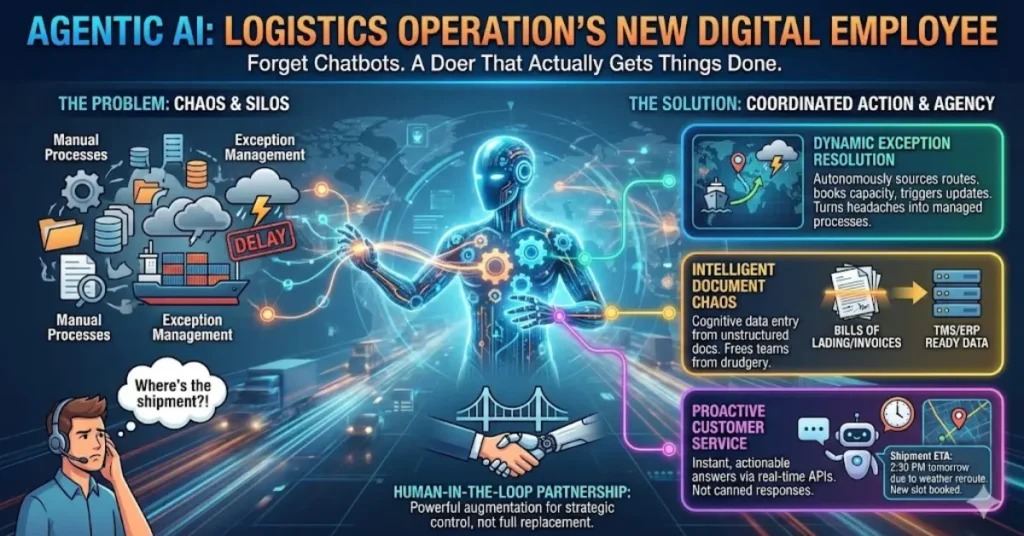
Let’s be honest, logistics is a beautiful nightmare of complexity. It’s drowning in manual processes, exception management, and data scattered across a dozen siloed systems. This is precisely where Agentic AI shines. It thrives on chaos and turns it into coordinated action.
Here are a few places where implementing Agentic AI is a total game-changer:
- Dynamic Exception Resolution: A storm shuts down a port. An Agentic AI system doesn’t just alert you; it automatically sources alternative routes, calculates cost impacts, books new capacity, and triggers pre-written customer communications. It turns a major headache into a managed process.
- Intelligent Document Chaos: Bills of lading, customs forms, invoices—the paperwork is endless. Agentic AI can be deployed to read, interpret, and extract data from these unstructured documents, pushing it directly into your TMS or ERP. This isn’t just automation; it’s cognitive data entry that frees your team from soul-crushing work.
- Proactive Customer Service: When a client asks, “Where’s my shipment and why is it late?”, an Agentic AI assistant can pull real-time data from tracking, weather, and carrier APIs to give a precise, actionable answer instantly, not a canned response.
But a crucial note: Agentic AI isn’t a magic wand for everything. You still need human judgment for highly regulated tasks (like final hazmat declarations) or strategic negotiations. The power of Agentic AI lies in partnership, not replacement.
The Nuts and Bolts: How Agentic AI Actually Works
Alright, so how do you build this digital employee? You don’t train a single, massive brain. Instead, you orchestrate a team of specialized skills using frameworks. Think of it like assembling a heist crew in a movie—you need the planner, the hacker, the driver.
Popular frameworks for building Agentic AI systems include CrewAI, which is fantastic for creating collaborative teams of agents, and LangGraph, which excels at mapping out complex, multi-step workflows. These toolkits let you give your Agentic AI access to the “tools” (like your warehouse management API or your carrier rate sheets) it needs to get the job done.
The architecture always involves key layers: the reasoning brain (a large language model), the orchestration layer (the framework), the tools (your business software), and a critical layer of guardrails to ensure everything stays safe and on track.
Implementing Agentic AI: A Realistic, No-Hype Roadmap
Everyone’s calling this the “Year of the Agent,” but let’s pump the brakes. The path to effective Agentic AI is littered with stalled pilots. Success comes from a gritty, practical approach.
- Start with the Pain, Not the Technology: Never begin with “We need Agentic AI.” Start with, “Our team spends 15 hours a week manually comparing freight quotes.” That’s your target. Agentic AI is the solution, not the starting point.
- Pilot on a Quick Win: Choose a contained, high-ROI task. Automating the first draft of shipment status updates or classifying incoming carrier emails. Prove value fast and use that win to build momentum.
- Audit Your Data Fuel: Agentic AI runs on data. If your systems don’t talk to each other via clean APIs, that’s your first project. The smartest agent is useless without access to information.
- Design for Human-in-the-Loop: The goal isn’t full autonomy. It’s powerful augmentation. Your Agentic AI should handle the legwork—gathering options, running calculations—and present a curated choice for a human to approve. This builds trust and ensures control.
Conclusion: The Future is a Partnership Between Human and Agentic AI
The real promise of Agentic AI isn’t a fully automated, lights-out warehouse. It’s the empowered planner, the strategic buyer, and the customer service rep who are freed from drudgery and armed with superhuman support.
Implementing Agentic AI is about building a collaborative future. It’s the most exciting shift in operational technology because it moves beyond insight to action. By starting with a clear problem, building a solid data foundation, and focusing on augmentation, you can turn this transformative potential into your most reliable digital workforce.
FAQs About Implementing Agentic AI
Q1: How is Agentic AI different from RPA or a basic bot?
RPA bots follow rigid, pre-programmed rules. Agentic AI uses reasoning to handle unpredictability. A bot can copy data from a fixed form; an Agentic AI system can interpret a chaotic email, extract the needed info, and decide what to do with it.
Q2: Is our company’s data ready for Agentic AI?
It’s a common hurdle. Start by asking: Is the data for your target process accessible via API or clean feeds? If not, there’s your step one. Agentic AI needs a connected data environment to work effectively.
Q3: What’s a realistic timeline to see ROI from Agentic AI?
With a well-scoped pilot on a specific task, you can see efficiency gains in quarters, not years. For a broader rollout, a 12-24 month timeline to substantial ROI is realistic, as it involves integration and change management.
Q4: What’s the biggest risk in adopting Agentic AI?
“Pilot purgatory.” Running a cool demo that never scales because it wasn’t tied to a critical business outcome. Avoid this by tying every experiment to a key performance indicator (KPI) you already care about.
Q5: Do we need a huge AI team to get started with Agentic AI?
Not necessarily. Many frameworks are simplifying development. However, you do need someone who understands your business processes deeply and can translate them into a workflow for the Agentic AI to follow. The business logic is more important than just the AI expertise.
Read Also: Warehousing and Logistics :The Engine of Commerce
Related Posts
Warehouse Management Systems: A Real-World, Down-to-Earth Solution for Today’s Warehouses
A friendly, conversational explainer on Warehouse Management Systems (WMS), how they work, why they matter, and how they can actually […]
Read More →
Supply Chain Technology: How the Next Wave of Tools Is Rewiring Logistics
Supply Chain Technology is no longer optional — it’s the backbone of resilient, efficient, and sustainable logistics. This article explores […]
Read More →
The AI Revolution in Logistics: How Artificial Intelligence is Reshaping the Global Supply Chain
Introduction: The Dawn of a New Era in Logistics What is the AI Revolution in Logistics? The world of logistics, […]
Read More →