
3D Warehouse in Supply Chain Management
Discover how 3D warehouse modeling and digital twins are helping businesses maximize vertical space, boost safety with VR training, and slash operational costs. Learn why the future of the supply chain is spatia
In the “old days” of logistics—which, let’s be honest, was only about ten years ago—warehouse management was a flat world. We looked at 2D blueprints, bird’s-eye view spreadsheets, and static maps. But as global supply chains have become more complex, “flat” just isn’t cutting it anymore.
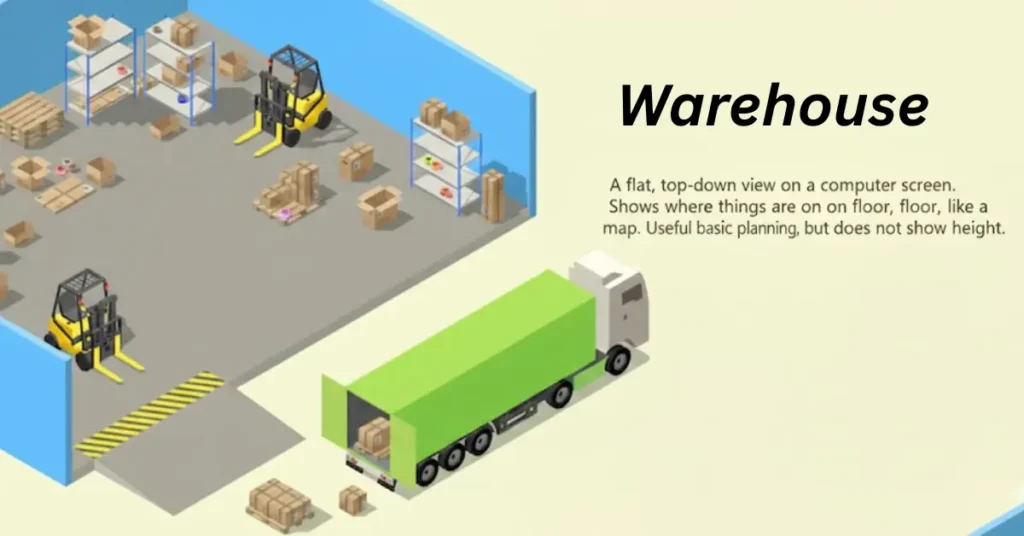
Think of a traditional 2D warehouse like a flat paper map of a city. It shows you the streets and where the buildings are, but it doesn’t tell you how tall the skyscrapers are or if a delivery truck will fit under a bridge. In a warehouse, 2D only looks at the floor. It treats the building like a giant drawing on a piece of paper, which makes it easy to accidentally waste all that empty space near the ceiling.
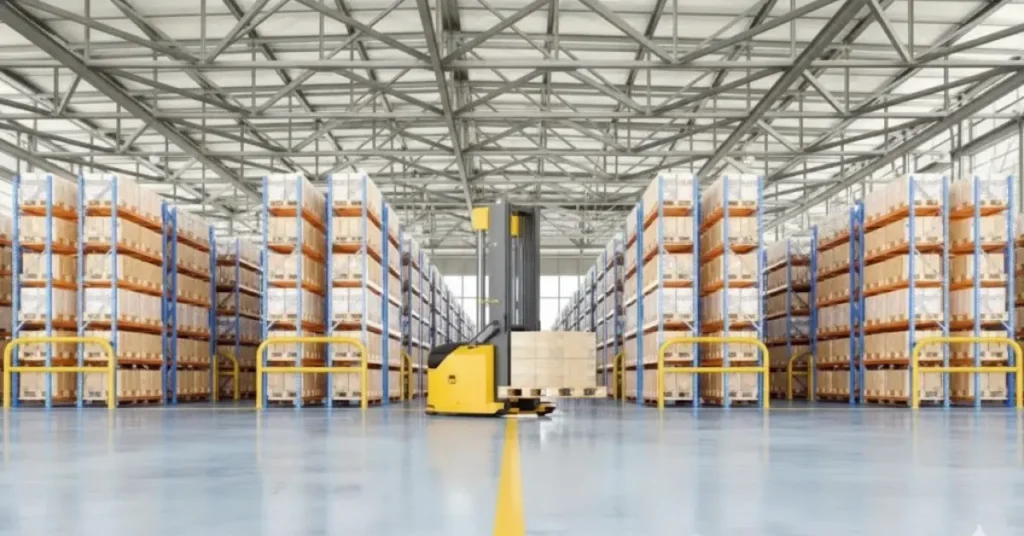
A 3D warehouse is more like using Google Earth or playing a video game like The Sims. You can see the entire building from every angle—up, down, and inside out. You can see exactly how high your shelves go and if a forklift has enough room to lift a pallet without hitting a ceiling fan.
The biggest difference? In a 2D warehouse, you have to move heavy racks and boxes in real life just to see if a new idea works. In a 3D warehouse, you can test everything on a computer screen first. It’s like “practicing” your work in a virtual world so you don’t make expensive mistakes in the real one.
Enter the 3D Warehouse.
Whether we’re talking about a digital twin of a massive distribution center or a library of 3D assets used to design a facility, 3D technology is no longer a “nice-to-have” luxury. It’s becoming the backbone of efficient, resilient supply chains.
In this article, we’ll dive deep into what a 3D warehouse actually is, how it’s being used to save millions in operational costs, and why your business might be falling behind if you’re still thinking in two dimensions.
What Exactly is a 3D Warehouse?
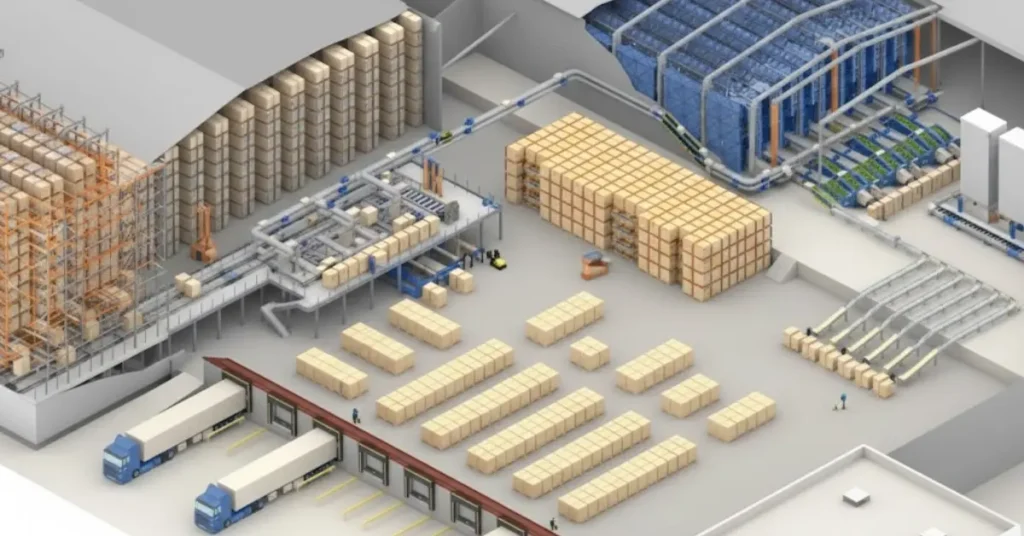
In a supply chain context, a 3D warehouse refers to the three-dimensional digital representation of a physical storage facility. Think of it as a “Digital Twin.” It isn’t just a pretty picture; it’s a data-rich environment where every rack, pallet, forklift, and conveyor belt is accounted for. This model is often connected to a Warehouse Management System (WMS) or an Enterprise Resource Planning (ERP) platform, allowing managers to see real-time data overlaid on a 3D map.
The Two Sides of 3D Warehouse Tech:
- The Design Side: Using platforms like SketchUp’s 3D Warehouse to pull pre-built models of industrial equipment to plan a layout.
- The Operational Side: Using sophisticated simulation software (like NVIDIA Omniverse or specialized supply chain digital twins) to monitor and optimize daily workflows.
1. Visualization: Seeing the “Hidden” Space
The most immediate benefit of a 3D warehouse is verticality. In a 2D floor plan, a square foot of floor space looks the same whether the ceiling is 10 feet or 40 feet high.
In the supply chain, air is expensive. If you aren’t utilizing your vertical cube, you’re wasting money. A 3D model allows managers to:
- Visualize Racking Density: See exactly how high-density racking affects lighting and sprinkler clearance.
- Identify Dead Zones: Spot areas above loading docks or office pods that could be used for mezzanine storage.
- Improve Safety: Identify “blind spots” for forklift drivers that aren’t obvious on a flat map.
2. Slotting Optimization and “What-If” Simulations
Slotting is the art and science of putting the right product in the right place to minimize travel time.
With a 3D warehouse model, you can run simulations. Instead of moving 5,000 pallets and hoping it improves efficiency, you can run a “digital experiment.”
Example: You can simulate a “Black Friday” surge. The 3D model can show you exactly where human pickers and robots will cross paths, creating bottlenecks. You can then rearrange the “virtual” inventory, re-run the simulation, and find the perfect layout before a single physical box is moved.
3. Integrating Automation and Robotics
We are entering the era of the “Dark Warehouse”—facilities fully operated by robots. However, integrating Autonomous Mobile Robots (AMRs) into a legacy warehouse is a nightmare without 3D planning.
Robots need to know the world in 3D. They need to understand shelf heights, incline gradients for ramps, and the reach of robotic arms. A 3D warehouse model acts as the “map” for these automated systems, ensuring that the transition from human-led to tech-led logistics is seamless and crash-free.
4. Enhancing Labor Training and Safety
Training a new hire in a 1-million-square-foot distribution center is daunting. It’s loud, it’s busy, and it’s potentially dangerous.
By using the 3D warehouse model in tandem with Virtual Reality (VR), companies are now “teleporting” new employees into a digital version of the warehouse.
- Safe Learning: New pickers can learn the layout and practice operating heavy machinery in a risk-free virtual environment.
- Gamification: Training can be turned into a 3D challenge, increasing retention rates and reducing the “time-to-competence” for seasonal workers.
Why 3D Warehousing is Trending
If you look at search trends for “Supply Chain Digital Twin” or “Warehouse Visualization,” the graph is pointing straight up. Why? Because the Cost of Inefficiency has skyrocketed.
With rising real estate costs and labor shortages, companies can no longer afford “trial and error.” They need “first-time right” precision.
| Benefit | Impact on Bottom Line |
| Reduced Travel Time | Lower labor costs and faster shipping. |
| Accurate Inventory | Fewer lost items and better “perfect order” rates. |
| Predictive Maintenance | Sensors in the 3D model alert you before a conveyor breaks. |
| Sustainability | Optimized routes mean lower energy consumption for EVs/forklifts. |
How to Get Started: The 3D Journey
You don’t need a Silicon Valley budget to start utilizing 3D in your supply chain.
- Start with the Assets: Use tools like the SketchUp 3D Warehouse to find models of the equipment you already use.
- Map Your Facility: Use LiDAR scanning (now available on many smartphones/tablets) to create a high-accuracy 3D mesh of your current space.
- Link Your Data: Connect your inventory spreadsheets to your 3D model. When a SKU goes out of stock, it should turn red in your 3D view.
- Scale to Simulation: Once you have the visual, move into “Digital Twin” territory where you can simulate physics and workflows.
How companies use “virtual reality”
Using Virtual Reality (VR) with a 3D warehouse model is like having a “time machine” for your business. Instead of looking at a screen, you put on a headset and actually step inside the warehouse before it even exists in the real world.
Here is how companies use this “Virtual Walkthrough” to save time and money:
1. The “Test Drive” Before Building
Imagine spending millions to build a warehouse, only to realize on the first day that the aisles are too narrow for your forklifts. With VR, managers can walk the halls of a 3D model to spot these mistakes early. They can check if a shelf is too high to reach or if a loading dock is placed in an awkward spot. Correcting a mistake in VR costs zero dollars, while fixing it in concrete can cost a fortune.
2. Supercharged Safety Training
Training a new employee on a heavy forklift is nerve-wracking. In a VR warehouse:
- Zero Risk: A new driver can “crash” into a virtual shelf a hundred times without hurting anyone or damaging a single box.
- Muscle Memory: They practice the exact movements they’ll use on the job, making them 275% more confident when they finally step onto the real floor.
3. “Day in the Life” Simulations
Companies run “What-If” scenarios. They can simulate a massive holiday rush where thousands of virtual orders fly through the system. By watching this in VR, managers can see where people get in each other’s way (bottlenecks) and fix the floor plan before the real-world rush starts.
The Final Word: Don’t Get Left Behind in 2D
The 3D warehouse is more than just a cool visualization tool—it is the control tower of the modern supply chain. It bridges the gap between the messy physical reality of moving boxes and the clean, data-driven world of digital management.
By adopting 3D modeling, you aren’t just looking at your warehouse; you’re understanding it. You’re seeing the friction points before they cost you money, and you’re building a facility that is ready for the automated future.
The question isn’t whether you can afford to move to 3D. Given the speed of today’s commerce, the question is: can you afford to stay flat?
FAQs
1. What is the main difference between a 2D and 3D warehouse?
A 2D warehouse is a flat, top-down map focused on floor space, while a 3D warehouse is a “Digital Twin” that includes height, volume, and real-time operational data.
2. How does 3D modeling save money in the supply chain?
It allows companies to run virtual simulations to find bottlenecks and testing layouts digitally, preventing expensive physical mistakes and reducing labor travel time.
3. Do I need expensive hardware to start with 3D warehousing?
Not necessarily; many managers start by using free libraries like SketchUp’s 3D Warehouse for basic design before moving to advanced VR or simulation software.
4. Can 3D warehouses help with employee safety?
Yes, by using Virtual Reality (VR), new employees can practice operating machinery and navigate the layout in a risk-free environment before entering the actual facility.
5. Is a 3D warehouse only for large corporations?
While large firms lead the way, small businesses increasingly use 3D models to maximize limited vertical space and plan for future automation as they scale.
Related Posts
Top 10 Logistics Companies in the World 2025: Leaders Shaping Global Trade
Lets explore the Top 10 Logistics Companies in the World 2025, The global logistics industry is the backbone of modern […]
Read More →
Mastering CEVA Logistics Tracking: A Complete Guide to Global Shipment Visibility
Lets explore CEVA Logistics Tracking. In today’s fast-paced global economy, the ability to monitor cargo in real-time is no longer […]
Read More →
Warehousing and Logistics :The Engine of Commerce
What is Warehousing and Logistics? The modern global economy is characterized by a rapid, continuous flow of goods from manufacturer […]
Read More →